
Systems we have built, and what they show
This is proof of practice, not a product catalogue.
Enblock is a Commercial Solutions Architecture firm, not a product company. But the best way to show how we think is to show what we have built. Each of the systems below started with a real workflow and was designed around evidence, controls, and human judgment. They are the same discipline we bring to client work, made concrete.
AccLines — run your books on AI, keep control of the ledger
The problem space
Finance and accounting work is full of repeated mechanical tasks: extracting data from bills, coding transactions, checking supplier details, reconciling bank lines, and preparing reporting packs. AI can help with this work. But finance teams cannot rely on black-box automation, because mistakes in finance have consequences.
The hard part is not extracting the data. The hard part is building the operating model around the AI: what did the AI produce, what evidence supports it, what checks passed, who reviewed it, who approved it, and can the decision be traced later.
What it does
AccLines is a complete set of books — supplier bills, customer invoices, bank reconciliation, financial statements, BAS, and a monthly close with locked periods — built so AI drafts the work and a person approves it. It is opening to a small group in early access at acclines.com.
- AI drafts the work. It extracts fields, suggests coding, proposes supplier matches, and flags anomalies — and every AI-filled value is highlighted, so it is instantly clear what needs checking.
- Nothing posts without a person. The AI never records anything on its own. Nothing reaches the financial statements without an explicit human action.
- Deterministic checks run alongside. Hard checks confirm that totals tie, duplicates are flagged, and required approvals exist. AI assists, but the controls are explicit.
- The audit folder builds itself. A permanent log records every edit, approval, and rejection, with source documents linked to entries as they are processed.
- Locked periods close the month. Once a period is closed, the record stays the record.
What it demonstrates
AccLines shows that AI can support finance operations without removing human accountability. Extraction accuracy will improve across the market. The more durable value is the architecture around trust.
CableBlock — a collaborative cable schedule and diagram workspace
The problem space
Engineering workflows often depend on spreadsheets, drawings, registers, and emails held together by manual updates. Cable schedules are a good example. The data is structured, but it is usually managed by hand. Diagrams and schedules need to stay aligned. Teams need to collaborate around technical records, changes need to be visible, and outputs need to be shared with other stakeholders. Manual handling creates delay, rework, and version confusion.
What it does
CableBlock turns a specific, spreadsheet-heavy engineering workflow into a structured web application. It is live in public beta at cableblock.io.
- Structured records replace loose spreadsheet data, so cable schedule information has a consistent shape.
- Generated diagrams turn those records into cable block diagrams, so the visual output stays aligned with the data.
- Collaboration happens in a shared workspace instead of files passed between people.
- Change tracking keeps updates visible, so the team can see what changed and when.
What it demonstrates
CableBlock shows how a repeated manual workflow can become a system people can use. It also shows why deeper technical workflows require careful modelling, not shortcuts. Not every workflow is easy to automate, and the honest answer is often that project administration is a better first step than deep technical work.
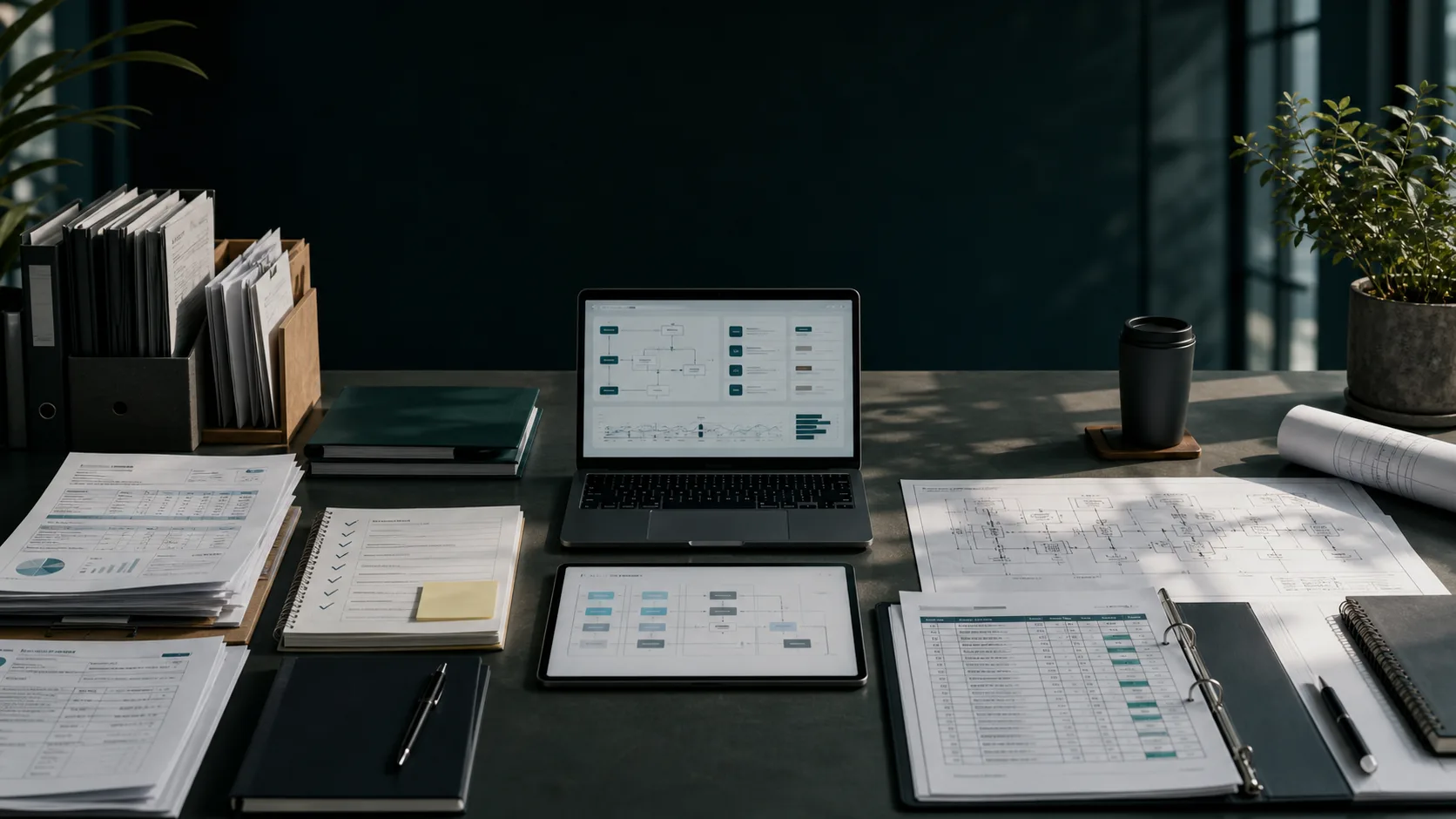
These systems inform the work
Building AccLines and CableBlock taught us where AI belongs, where it does not, and what it takes to make a system that people trust and actually use. That is the same thinking we bring to the Practical AI Workshop.
The workshop is where most engagements begin. We work through your operation with you to find where AI could realistically help, where it should not be used, and what a sensible first workflow could look like.